Blueberries: the key is balanced nutrition
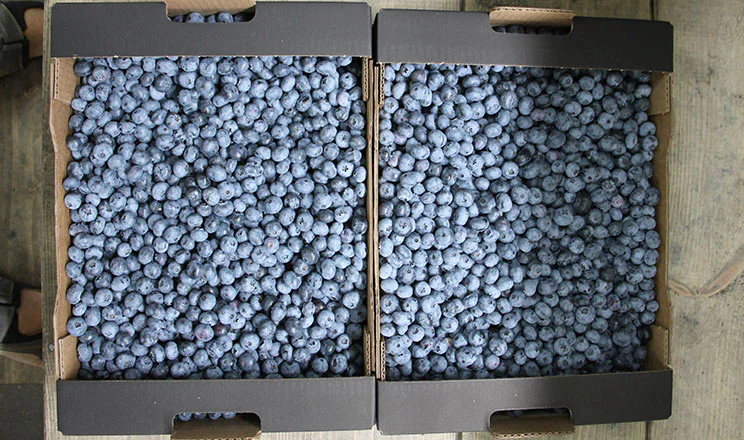
BETEK hardly needs an introduction: for 10 years it has been the largest producer and exporter of blueberries in Ukraine. Today the company operates a 500 ha berry plantation, 325 ha of which are bearing, and exports 2 thousand tonnes of blueberries a year to England and the Netherlands. Wholesale buyers’ requirements for exported berries are extremely high, so the company takes a very responsible approach to producing high-quality fruit, including through its nutrition program. How they manage it was explained by Viktor Farafonov, director of BETEK LLC.

Viktor Farafonov
– Mr. Farafonov, briefly tell us about the specifics of your blueberry growing technology.
– We grow blueberries in the Novohrad-Volynskyi district of Zhytomyr Region. We chose this place because of the light soils and the available labour for working on the plantations. We use the American blueberry growing technology, under which a bush is harvested only in the third year after planting — that is when we got a small crop, and a normal one in the 5th-6th year. We grow blueberries on beds covered with long-life polypropylene film. We use drip irrigation and fertigation.
– What are the specifics of blueberry nutrition?
– There can be different options, but we practise nutrition through fertigation. We cannot apply fertilizers in dry form because our blueberry root system is covered with film. So there is no way to apply fertilizers other than through irrigation water.
Another feature is that our crop likes an acidic environment, so we prefer fertilizers with a fairly low pH. For growth and development, blueberries need the same nutrients as other plants — nitrogen, phosphorus, potassium, magnesium, calcium and sulphur, as well as micronutrients involved in photosynthesis.

Our crop needs quite few nutrients to form a harvest. Its distinctive feature compared to other plants is the absence of root hairs; they are replaced by mycorrhiza — symbiotic fungi that settle on the roots of the bush. So our crop actually consists of two organisms — a symbiotic mycorrhizal fungus of the genus Glomus and the plant itself. Therefore, we must provide nutrition not only to the plant but above all to the mycorrhizal fungus, which feeds on the elements we apply through the irrigation system and passes the nutrients the plant needs on to it. In turn, the blueberry feeds the fungus with sugars produced through photosynthesis. Our task is not to harm either organism, to provide balanced nutrition and not to oversaturate both organisms with nutrients. So in practice we use only NPK and micronutrient fertilizers.
– What criteria do you use to choose fertilizers?
– We need fertilizers that dissolve well, because we supply them through the drip system, so it is important that the emitters do not clog. As for the composition of fertilizers, we choose them based on the content of a particular element depending on the crop’s needs. For example, at one stage the plant needs more nitrogen, at another — more phosphorus, so we choose an NPK with the formula we need.
I believe the berry should be given all elements in a balanced way — then it will have taste and quality. Although, of course, the genetics of the variety play a huge role here.

– There are a lot of fertilizers on the market now. How do you choose the right ones?
– We do not buy fertilizers directly from manufacturers; instead, for more than five years we have been using the services of BINFIELD . It is one of our main suppliers of NPK and micronutrient fertilizers. Their specialists choose fertilizer manufacturing partners very carefully and offer effective fertilization solutions. They cooperate with well-known European companies in various areas, so they can provide a fertilization program that takes into account the smallest nuances. In addition, they have a well-established supply system — we always receive our orders on time. Their flexible pricing policy is also important to us: as a large producer, we can always count on good discounts, which is very important for us.
As you rightly said, it is not difficult to buy any fertilizer today — the market is saturated with them. But BINFIELD employs professionals who select the best products and recommend them expertly, offering those best suited to our conditions. We always discuss every new offer in detail and test products on trial plots that we set up every year — different forms of fertilizers, different application methods (fertigation, foliar) — and choose the best. As a result, we are satisfied with the quality of the goods, the terms of cooperation and timely deliveries.

Previously, when we used simple salts on blueberries, such as magnesium sulphate, ammonium sulphate, monopotassium phosphate, potassium sulphate, etc., BINFIELD supplied us with most of the products on the list. All of them were of high quality and dissolved well. And we got yields of 10-14 t/ha. By the way, we consider an average of 7 t/ha over a large area a good harvest.
Two years ago, we switched to complex fertilizers; now they supply us with the complex water-soluble fertilizers NovaTec Solub with a nitrification inhibitor, which prolongs the action of ammonium nitrogen in the soil and takes into account the biological characteristics of our crop. Depending on the development stage, we choose the required grades, for example: NovaTec Solub 13-33-13, NovaTec Solub 19-5-5, NovaTec Solub 18-18-18 or NovaTec Solub 10-5-30 and others. In addition, we constantly test other products: Basfoliar Combi Stipp SL, Basfoliar Boron SP and new developments aimed at improving berry quality, storability and transportability.
We plan to continue using NovaTec Solub, because our production is quite conservative, and there is no point in changing fertilizers every year — that can only harm the plant.
– You said that low-pH nutrition is very important. Do you use water acidity regulators?
– No, we do not use regulators. But we don’t need them, because BINFIELD fertilizers have a low pH due to their high sulphate content, which softens the water. What matters to us is that fertilizers dissolve, leave no sediment and contain no impurities, because our products are exported and checked for heavy metals, and, of course, that their content matches what is stated on the package. NovaTec Solub fertilizers meet these requirements. We tried it last year and liked it. This year we bought it again for the entire area.

– Finally, how do you think the blueberry market will develop this year?
– Right now, until blueberry flowering is over, it is very hard to forecast. This year is very abnormal — a cold April, frosts in March and even at the end of May, which usually does not happen. In the last ten days of May, temperatures in Poland dropped to -7 degrees. The situation in Ukraine is also alarming — the crop has been severely damaged by spring frosts. And even now, during flowering, night temperatures are very low, which has a bad effect on the development of vegetative buds. So I won’t venture a forecast.
In general, the blueberry market still has room to grow; new players keep appearing. In particular, Ukraine is forming a premium segment, a mass market and a processing market. So I think producers still have somewhere to sell berries, but they will not make windfall profits.