Ihor Kostyshyn: “Today, agricultural producers are less focused on growth and more on preserving what they already have”
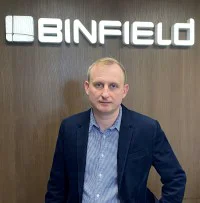
BINFIELD recently joined UCAB. Ihor Kostyshyn, BINFIELD Executive Director for VIP Client Relations, talked about how the complex fertilizer market has changed over the past 10 years, whether agricultural producers have become more cautious because of the coronavirus crisis, and about the importance of conducting trials and bringing new products to market.
Tell us when your company was founded and how long you have been working on the Ukrainian fertilizer market?
Together with my two partners and like-minded colleagues, we founded BINFIELD in September 2011. At the same time, we started cooperating with two manufacturers new to the Ukrainian market: the Lithuanian company UAB Arvi Fertis and the German company COMPO EXPERT GmbH. Since then, for almost 10 years now, we have been the exclusive representatives of these companies’ products and their ambassadors in Ukraine.
Have you noticed how the Ukrainian fertilizer market has changed over this time?
I would say that over these years the complex fertilizer market has changed radically. Its very idea and logic have changed. People began applying fertilizers taking into account the technology for specific crops and soil analysis results. In addition, new products have appeared. For example, micro-granulated fertilizers appeared on the market, which our company also works with, and liquid fertilizers are gaining great popularity. So the market is moving towards effective and technological products, towards a qualitative improvement of mineral nutrition.
And who are your company’s customers? Are there more holdings or small farms among them?
In our company, two independent divisions are responsible for working with customers. The first is the corporate sales department. It works with holdings and large companies. Its customers include probably all the best-known companies on the market — in particular MHP, Kernel, Astarta, Agro Region, APK-INVEST, Vitagro, Continental Farmers Group (formerly Mriya) and others.
The second division is direct distribution sales. We set it up in 2016. The department team consists of about ten managers, and they work directly only with end consumers. These are also agricultural enterprises, which in structure can sometimes be called mini-holdings, but their land bank is up to 10 thousand hectares.
If we compare these divisions in percentage terms, direct distribution probably accounts for 60% and corporate sales for 40%.
Do you see any changes in how your customers prepare for the new season and purchase fertilizers: have they started saving on anything because of the coronavirus crisis?
I believe the coronavirus has affected agricultural businesses least of all, whether traders or agricultural producers. Many enterprises probably had more problems with drought than with the coronavirus. In particular, farms in central and southern Ukraine faced this problem. But customers’ mood has changed anyway: they have become more careful, more demanding and more cautious. Although, thanks to the crisis, the price of their products almost doubled compared to last year, seeds, plant protection products and fertilizers also became more expensive.
Farmers have become less frivolous about spending money, because no one knows what will happen next year. So now they more often choose to be more prudent. You can feel that they are less focused on growth and more on preserving what they already have.
Your company often conducts trials and takes part in other companies’ trials on effective agribusiness management, such as the Digital Field online demo site. What does participation in such projects give you, and why are you interested?
We conduct a great many studies of this kind. In addition, we have our own R&D centre at the Druzhba-Nova enterprise in the village of Varva, which is part of the Kernel agricultural holding. In 2015, our company was the first in Ukraine to set up a demonstration field dedicated purely to mineral nutrition. Before that, trials were conducted by seed and plant protection producers, but not by mineral fertilizer producers.
Now our demo field has more than 150 nutrition variants on five crops on 30 ha.
As for Digital Field, in which we took part last year and have already signed an agreement for 2021 as the exclusive fertilizer partner, we see this project as an opportunity to convey information about our products to end customers, because we sell not just fertilizers — we sell agronomic nutrition technologies for different conditions.
This year the project should be much larger. In particular, a significant increase in area is planned, and the trial will come quite close to the industrial level of agricultural production. Thus, the customer will be able to use an idea from it directly on their farm and make certain changes to their technology.
I would also like to note that, in addition to the R&D centre and Digital Field, we set up many trials at various enterprises in Ukraine — in 2020 alone, more than 70: in different regions, on different crops, in different variations.
And how willingly do Ukrainian agricultural producers listen to the advice of your agronomic service? Are they ready to change their technology according to your advice?
I would say that agricultural producers listen to the advice of our agronomic service quite actively. About 50% of customers change their technology and involve our specialists in their technologies and crop rotations. To say 100% would be untrue, because today the level of agronomists at enterprises is very high. These are people with experience and practice; money is invested in their education, they travel the world and study foreign practices… Today, the level of agronomy in Ukraine is very high.
Last year, a working group of specialists from your company and your farming partners launched the production of a new grade of complex mineral fertilizer. What will this group’s specialists work on this season? Will there be any new product?
We are constantly bringing new products to market. Science moves forward, everything develops and people want something new. We were among the first to drive the market for micro-granulated fertilizers under the Easy Start TE-Max brand. They are applied at sowing with applicators in the row at a low rate. We started introducing this technology back in 2012 and are still the main supplier of this type of fertilizer to the Ukrainian market, although competition today is already quite high. We also have a new product, NovaTec One. It is a nitrification inhibitor. This is also something new for us — products that prolong the action of nitrogen, making it possible to reduce nitrogen fertilizer use by up to 25%.
In addition, at our partner Arvi’s plant in Lithuania we can produce about 150 types of formulations. This allows us to produce a formula that suits a specific agricultural producer and their soil analysis. That is why many products appear precisely in response to our customers’ requests. These include, in particular, fertilizers with an increased micronutrient content. If standard fertilizers usually contain 0.2% or 0.02% of certain micronutrients, at a customer’s request we can add, for example, 1% zinc, which is actually a very high concentration and makes it possible to avoid foliar zinc feeding. There are also fertilizers with a complex of micronutrients containing up to 5-7 compounds. And while last year we had only one such premium product, this year we expanded the line to five premium formulas with an increased micronutrient content.
In the summer there was much discussion about restricting fertilizer imports. Do you see real threats from fertilizer imports for Ukrainian producers? Are there sufficient grounds to restrict them?
I believe there are no sufficient grounds to restrict fertilizer imports. That is why our company was one of the active negotiators in the summer, when this issue was raised at meetings at the Ministry of Economy. Our view is that today there is no threat to Ukrainian fertilizer producers, and restricting imports is dangerous. If it is introduced, it will lead to market monopolization. We have a fertilizer producer that holds a monopoly position, so products will become more expensive, because when there are no competitors, there are no healthy economic relations. The price will be set at whatever level suits the fertilizer producer, and no one will pay attention to the needs of agricultural producers, who also bring foreign currency into the country and pay taxes…
What do you expect from membership in the Ukrainian Agribusiness Club association?
Our company works on the principles of trust and support, and we understand that one person alone is not an army. We see the Ukrainian Agribusiness Club as a reliable partner and support in lobbying the interests of the Ukrainian agricultural sector. During the negotiations at the Ministry of Economy we saw UCAB in action, and it was then that we realized what a powerful platform it is and immediately found like-minded people there.