It is becoming something of a tradition: before the spring field work season, Ukrainian customs blocks imports of mineral fertilizers. This time they are again looking for a “Russian trace” in their production. The market fears this will lead to a fertilizer shortage, and the top-dressing of winter crops, which starts in a few weeks, will be at risk of disruption.
On the other hand, market participants confirm that Russian and Belarusian fertilizers repackaged in non-sanctioned countries continued to enter Ukraine. But did Ukrainian customs choose the right method by stopping all imports? We asked market participants what such a blockade could lead to and what mechanism for controlling the origin of fertilizers they propose.
So, what happened?
Since 1 January, the State Customs Service of Ukraine has not been clearing fertilizers until they pass laboratory checks for compliance with the declared classification codes, the presence of precursors and a “Russian trace” in their production.
The basis for blocking imports is an order from the SBU received by the heads of all customs posts. The letter states that they must, under their personal responsibility, ensure the mandatory involvement of the customs laboratory when clearing mineral fertilizers.
This is done “to verify that true information is declared in customs declarations and shipping documents, to prevent attempts to finance terrorism and attempts to circumvent the ban on importing goods from the Russian Federation”.
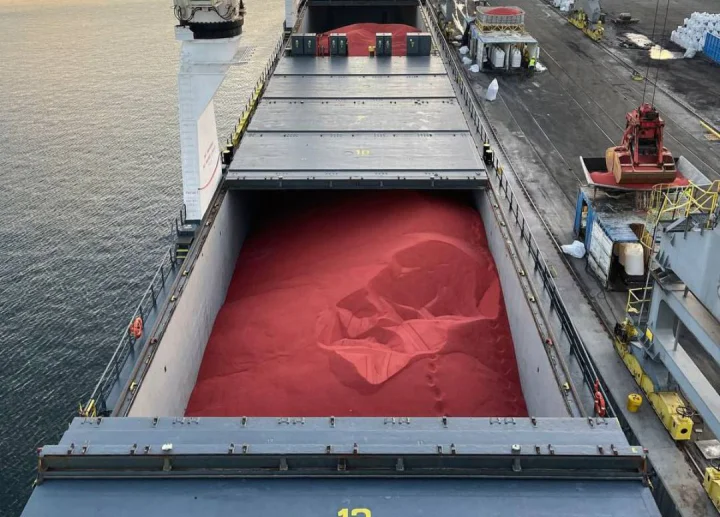
According to member companies of the Ukrainian Agribusiness Club (UCAB), as of 15 January at least 12 thousand tonnes of mineral fertilizers from 20 different batches were known to be blocked at customs. They were heading to Ukraine by ship, rail and road.
Ukrainian Agro-Industrial Group submitted samples to the laboratory back on 4 January and has still not received the results. So a barge with granular ammonium sulphate is still standing uncleared.
director and founder of Ukrainian Agro-Industrial Group
“Everything is now being done to delay cargo clearance by 2-3 weeks. And, unfortunately, customs’ position is firm — they do not want to speed up this process. Up to 10 ships with uncleared fertilizers are now idle in the Danube ports.”
UCAB notesthat most of the blocked batches came from the EU from well-known fertilizer manufacturers.
For example, one market player has had a 40-car train idle at customs in Lviv Region since 4 January; it was supposed to deliver NPK (about 2 thousand tonnes) from a well-known manufacturer Yara. The situation is similar: customs requested a laboratory examination, although the company had documents confirming the country of origin of the goods.
BINFIELD faced this problem on 3 January during the customs clearance of FERTIS 8-24-24 complex fertilizers produced by Marijampoles NPK (Lithuania). This product is one of the key ones in the company’s portfolio and is imported regularly for the needs of large agricultural producers.
Head of Logistics and Foreign Trade at BINFIELD Group Valentin Pervanchuk says that despite having an EUR1 certificate, in January the company received a verbal demand to provide a certificate of origin from the CCI (Chamber of Commerce and Industry — ed.) on behalf of the manufacturer, otherwise — sampling without the right to file a temporary customs declaration.
Valentin Pervanchuk
Head of Logistics and Foreign Trade at BINFIELD Group
“The manufacturer fulfilled this requirement and provided a certificate from the Lithuanian CCI. Unfortunately, we incurred losses related to rail cars being idle during customs clearance. These days another batch of FERTIS 8-24-24 fertilizer arrived, for which the customs authorities decided to take samples to determine the correctness of classification according to the UKTZED, determine the country of origin and establish whether the goods are narcotic drugs, psychotropic substances or precursors.”
Does blocking imports benefit someone?
Market participants say the story has been repeating itself systematically since 2019, when the embargo on Russian fertilizers was introduced.
Some see the hand of Dmytro Firtash’s OSTCHEM in this: “It looks like OSTCHEM is putting a spoke in importers’ wheels.” Others say that this used to be the case, because it was specifically imports of the nitrogen group that were blocked. Now all types of fertilizers are being blocked.
How were fertilizers cleared before?
Volodymyr Triukhan says that on 17 October 2023, amendments to the Customs Code of Ukraine regarding customs formalities for fertilizer clearance came into force. Before that, a meeting was held at the Cabinet of Ministers of Ukraine chaired by Yuliia Svyrydenko, where a list of documents needed to check for a “Russian trace” was agreed. It was about providing the entire chain of cargo delivery from the country of manufacture to Ukraine.
Volodymyr Triukhan
director and founder of Ukrainian Agro-Industrial Group
“For example, if goods were produced in Azerbaijan and come to Ukraine from a port in Turkey, we showed the entire supply chain: how the goods were delivered to the port, by which trucks, a list of those trucks, and so on. All of this could be easily checked.”
Denys Dmytriiev explained this in more detail. He recalled that last year fertilizer importers had a number of meetings with customs management, consulting and suggesting how imports of repackaged Russian or Belarusian fertilizers through third countries could be completely restricted. In particular, customs officers asked whether chemical analysis could reveal who the manufacturer was. All the importers’ representatives assured them that this was impossible.
Instead, they proposed controlling the entire supply chain and all logistics links, which made it possible to cut off most of such imports. And this was implemented.
According to Denys Dmytriiev, some importers did not like the practice of showing the entire supply chain, especially those who brought goods of dubious origin from third countries. Some importers may have “sinned” without realizing it. But for “white” imports that have been on the market for many years, this posed no significant problems, and they quickly adapted. A small amount of extra work was added, nothing more. In the end, the market began to live by the new rules.
As for fertilizers originating from Central Asia or the Caucasus, where there may be difficulties in providing supporting documents for the entire supply chain, all conditions could be discussed with suppliers at the time of contracting, including the provision of the necessary package of documents. After all, traders selling, say, Turkmen, Uzbek, Kazakh or Azerbaijani fertilizers understand the situation in Ukraine, and there were usually no issues.
Were repackaged Russian and Belarusian fertilizers brought into Ukraine?
Can a “Russian trace” be found in the laboratory?
How can a “Russian trace” be checked without blocking all importers?
According to the market participants we interviewed, it is practically impossible. Denys Dmytriiev explains that chemical analysis of fertilizers gives no such understanding in 99.9% of cases. The remaining 0.1% applies only to certain fertilizers where it is possible to determine that they are Russian, and even then rather by appearance than by chemical composition.
Denys Dmytriiev, Commercial Director of Sanagro Ukraine
“Some Russian-made fertilizers have a specific colour and granule shape. The authorities probably realized this too, so they started additionally looking for precursors in fertilizers.”
According to him, at the end of 2018 importers had already gone through a similar situation, when customs was looking for precursors in fertilizers. Almost nothing was cleared for nearly a month, and in the end, having found nothing and explaining nothing, they decided to unblock imports.
Valentin Pervanchuk also says that, with product samples from a specific manufacturer, the origin of the goods can be determined by external features or analysis (typical colour, granule size, content of main elements). However, this applies to a limited range of products. As for fertilizers produced by chemical synthesis, the very possibility of determining the country of origin through analysis is extremely doubtful. For example, phosphoric acid or ammonia have the same chemical formula at all manufacturers.
Director of UkrKhimExport Oleksii Malevanets also says that it is impossible to determine the country of origin of fertilizers this way.
Oleksii Malevanets, Director, UkrKhimExport LLC
“Except perhaps by the anti-caking agent. But there is a nuance here too. Russians can use an American or German anti-caking agent, and then the analysis will show that the fertilizers have no ‘Russian trace’. As for phosphate, complex and potash fertilizers, a laboratory analysis can theoretically be done that may indicate by indirect signs which deposit the potassium or phosphorus comes from. But this will be a very approximate analysis, and the origin of the main elements cannot be determined for all types of mineral fertilizers. Therefore, I consider the laboratory examination method inappropriate, not objective and lengthy.”
Importers’ losses
As noted by UCAB General Director Oleh Khomenko, the problem is not the sampling itself but the blocking of the movement of fertilizer transport to warehouses, since research is usually carried out in parallel and should not block deliveries, as provided by the Customs Code.
“This causes huge losses due to idle transport, disruption of delivery dates under existing contracts and jeopardizes the further supply of fertilizers for the spring sowing campaign, as top-dressing of winter crops starts in a few weeks,” UCAB says.
As for idle time, market participants reported that demurrage on ships amounts to $3-5 thousand per day. Idle trucks cost €50-100 per day (depending on whether the truck is Ukrainian or European). Now calculate the losses they may incur if laboratory testing of samples can take 10-30 days.
“Everyone thinks importers are making a fortune on fertilizer imports, but in reality the margin is around $10-15/t. And if you have $2/t per day of idle time, after 5 days the economics become zero. If more — those are your direct losses, because most of these volumes have already been contracted by agricultural producers, prices have been agreed and no one will revise them.”
Of course, businesses cannot count on compensation for losses due to clearance delays. However, as Denys Dmytriiev notes, there is an existing mechanism for the period of checking a cargo — releasing it into circulation under a temporary declaration. On the one hand, this would allow the supervisory authorities to carry out the necessary checks, businesses not to incur losses, and farmers to receive their fertilizers on time.
Will farmers be left without fertilizers? And what will happen to prices?
According to Oleksii Malevanets, clearance delays will push up mineral fertilizer prices, making the Ukrainian agricultural producer even less competitive.
According to him, fertilizers are already rising in price. For example, before the clearance problems, ammonium sulphate cost UAH 13.2 thousand/t including VAT at the port of Izmail; now it costs UAH 15.2 thousand/t including VAT. An increase of UAH 2 thousand/t in 3 weeks is a very high rate of price growth. And it is not even the season yet.
Oleksii Malevanets, Director, UkrKhimExport LLC
“In addition, clearance problems have already led to reduced import volumes, and this is already a hint that in spring there will be a shortage of mineral fertilizers on Ukraine’s domestic market. Fertilizers mean harvest. Harvest means foreign currency for Ukraine. Therefore, I believe a working group with representatives of the Ministry of Economy, customs, industry associations and the CCI of Ukraine should be created immediately to develop a transparent and unified mechanism for assessing the country of origin of fertilizers during customs clearance.”
There will most likely be no catastrophic situation with ammonium nitrate.
According to Denys Dmytriiev, a slight shortage is possible during peak periods, but the domestic producer will be able to cover it, albeit with a delay for the farmer.
But the domestic producer will not be able to cover 100% of urea needs, so it is possible that there will not be enough for everyone on the market.
The situation is similar with ammonium sulphate. It used to be produced in sufficient volumes by Sumykhimprom. But last season the plant did not start production and probably will not start in the current season either.
Accordingly, Ukraine imports almost all of its ammonium sulphate. The exception is a small share produced domestically from coke-chemical raw materials of domestic origin. All the main volumes of ammonium sulphate contracted by importers are due to arrive in January-February.
“If fertilizer clearance continues to be blocked, there will be a huge shortage in these items, which the farmer will have nowhere else to buy. Another negative consequence of such ‘blocking’ may be a rise in the price of existing fertilizer stocks, which ultimately will only complicate the already difficult life of our farmers.”
What happy ending can we expect?
Yevhenii Vorobiov says that market participants have submitted their proposals to the Ministry of Agrarian Policy and Food of Ukraine on how to control the “Russian trace” in imported fertilizers. The ministry will further work out these proposals with customs.
So there is every hope that this story will end happily and farmers will receive their fertilizers before spring field work.